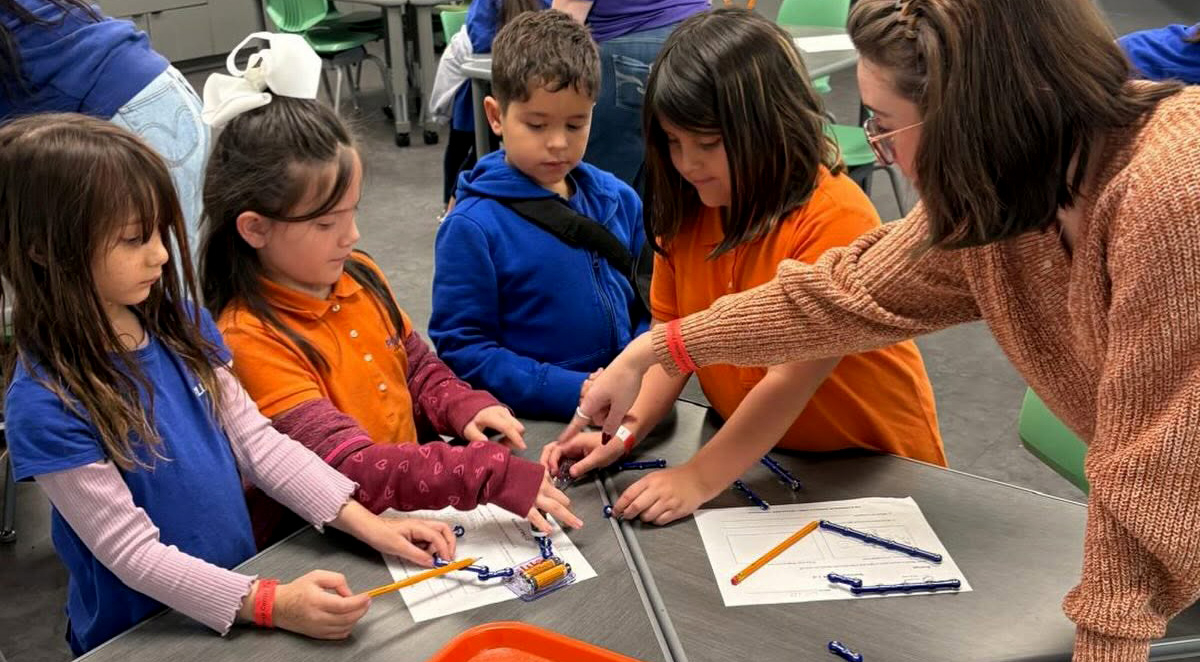
Every family touring a private school asks about class size, and for good reason. Parents intuitively understand that a child sitting in a room with 28 other students has a different school day than a child sitting in a room with 14. What is harder to articulate is exactly what changes, and whether that difference is worth building an entire educational model around.
At Pluris Academy in Orlando, small class sizes are not a marketing footnote. They are the structural condition that makes everything else we do possible: the project work, the entrepreneurial pathways, the individualized pacing, and the relationships between teachers and students that turn a school into a community. This article looks at the research behind class size, explains what small actually looks like on our campus, and shows how it reshapes the daily experience for a student.
Quick Summary
- Landmark research from Tennessee's Project STAR found that students randomly assigned to small classes of roughly 13 to 17 students scored significantly higher in reading and math than peers in classes of 22 to 25.
- Long-term follow-up research linked small early classrooms to higher college attendance rates and lasting gains in non-cognitive skills.
- Florida law caps public school core classes at 18 students in PreK through grade 3, 22 in grades 4 through 8, and 25 in grades 9 through 12, and many non-core classes have no cap at all.
- Pluris Academy publishes an average class size of approximately 15 students with a student-to-teacher ratio of 12:1.
- Small classes are what make project-based and entrepreneurial learning viable, because a teacher can coach individual teams rather than manage a crowd.
- Families comparing Orlando schools should ask about class size by course, not just the school-wide average.
What the Research Actually Says About Class Size
Class size is one of the most heavily studied variables in education, and the evidence is more interesting than the sound bites suggest.
The Landmark Study: Project STAR
The most rigorous evidence comes from Tennessee's Student/Teacher Achievement Ratio experiment, known as Project STAR. Beginning in 1985, students and teachers were randomly assigned to small classes of 13 to 17 students, regular classes of 22 to 25 students, or regular classes of 22 to 25 with a full-time teacher's aide, and the cohort was followed from kindergarten through third grade. Random assignment is what makes this study unusual and credible, because it removes the possibility that motivated families simply selected into better classrooms.
The results were consistent. Students in the small classes scored significantly higher than students in regular classes in both reading and math, and the effect held across school types. A later policy review of more than 25 years of class-size work concluded that small classes in the early grades deliver both short- and long-term benefits for students and teachers.
The Long-Term Picture
The more compelling findings came decades later. When researchers linked the original STAR participants to administrative records, they found that students who had been in small classes were significantly more likely to attend college. They also found something that matters enormously for how we think about education: while test score effects faded in later grades, gains in non-cognitive measures persisted.
That last point deserves emphasis. Habits like persistence, self-direction, collaboration, and the willingness to speak up are exactly the traits that determine whether a student can lead a team, pitch an idea, or navigate ambiguity. Those are the outcomes Pluris was built to develop, as described in our mission and vision.
Why the Effect Happens
Researchers studying instructional quality in the STAR data concluded that the advantage came largely from better instruction inside smaller rooms. Fewer students means less time spent on classroom management, more time on content, more individual feedback loops, and more opportunity for a teacher to notice when a specific student has quietly stopped understanding.
What Small Class Sizes Look Like at Pluris Academy
Numbers matter, but so does structure. Pluris publishes an average class size of approximately 15 students and a student-to-teacher ratio of 12:1. Those figures place our classrooms squarely inside the range that Project STAR identified as beneficial, and well below the maximums permitted in Florida public schools.
Our Garage Structure
Pluris is organized around three primary "garages," each aligned to a developmental stage:
- Ages 5 to 10: focused on creativity, curiosity, and foundational skills, detailed on our elementary school page.
- Ages 10 to 13: focused on building entrepreneurial skills and moving thinking from concrete to abstract, described on our middle school page.
- Ages 13 through high school graduation: focused on careers, startup creation, and technology as a developmental tool, outlined on our high school page.
Each garage is intentionally small so that a facilitator can hold every student's progress in mind at once.
Seminar-Style, Not Lecture-Style
Our middle school classes are small and discussion-based, and our Upper School curriculum is taught in small, seminar-style classes that emphasize inquiry along with written and oral expression. That format collapses if the room is too full. Twenty-eight students cannot each contribute meaningfully to a single discussion in a 50-minute period, so participation becomes optional and the quietest students disappear.
At Pluris, disappearing is not an option. Our teachers function as facilitators who ask questions to spark curiosity rather than delivering content to a passive audience. You can meet the educators behind that model on our faculty and staff page.
How Teachers Differentiate When They Know Every Student
Differentiation is a term schools use often and deliver on rarely, because true differentiation requires knowing each learner well enough to adjust for them. Here is what becomes practical at a 12:1 ratio:
- Diagnosing quickly. A teacher who reviews 15 sets of work rather than 140 can spot a misconception within a day, not a grading cycle.
- Adjusting pace in real time. Students who master a concept early move into extension work while others receive reteaching, without either group waiting on the other.
- Giving immediate feedback. Feedback delivered during the work is far more useful than feedback delivered a week after the unit ends.
- Assigning roles intentionally. In project teams, a teacher who knows each student can place a reluctant presenter in a role that stretches them safely.
- Communicating specifically with families. Parent conversations become about a particular student's trajectory rather than a generic grade report.
The Contrast: A Large Classroom Versus a Small One
Florida sets constitutional limits on public school class size, but those limits are ceilings rather than goals. Core-curricular classes may not exceed 18 students in prekindergarten through grade 3, 22 students in grades 4 through 8, and 25 students in grades 9 through 12. Just as importantly, the class size requirements do not apply to extracurricular classes, and a 2010 statutory change reclassified roughly two-thirds of previously covered courses, meaning many electives and advanced courses carry no cap whatsoever.
The difference for a student is straightforward. In a large section, a student can go a full week without speaking. In a room of 15, a student is asked a direct question most days, and the teacher notices when the answer is off.
Why Small Classes Accelerate Project-Based and Entrepreneurial Learning
This is where class size stops being a general good and becomes specifically essential to how Pluris teaches.
Project-based learning is not a worksheet distributed to 30 desks. It is several teams working on different problems, at different stages, with different obstacles, all in the same room. Supervising that requires a teacher to circulate as a coach, and coaching is a function of ratio. Our Garage model depends on that circulation, and our blog on how project-based learning develops real-world skills explores the method in more detail.
Questions Worth Asking on Any Orlando School Tour
When you evaluate schools, push past the brochure figure:
- Is the number an average, a cap, or a school-wide student-to-teacher ratio? These are three different things.
- What is the largest class my student would actually sit in next year?
- Do class size limits apply to electives and advanced courses?
- How often does a teacher give individual feedback on major work?
- Can the teacher describe my student's learning profile without checking a file?
Frequently Asked Questions
What is the class size at Pluris Academy?
Pluris publishes an average class size of approximately 15 students and a student-to-teacher ratio of 12:1. Because enrollment varies by grade and course, we recommend confirming current figures for your student's specific grade during a campus visit, which you can arrange through our contact page.
Does a smaller class really improve academic outcomes?
The most rigorous evidence, drawn from a randomized experiment, found meaningful achievement gains in classes of roughly 13 to 17 students compared to classes of 22 to 25. Later follow-up work also found higher college attendance among students who had been in small classes, along with lasting gains in non-cognitive skills.
How do small classes affect a shy or reserved student?
Reserved students often benefit most, because a small room makes participation expected rather than optional. Teachers can invite contributions in low-pressure ways and build confidence gradually instead of allowing a student to remain unnoticed.
Are small class sizes only important in elementary grades?
The original research focused on the early grades, but the mechanism applies at every level. Seminar discussion, project coaching, and college advising in high school all depend on a teacher having the time and attention to work with students individually.
How does class size affect tuition?
Maintaining a low ratio requires staffing accordingly, and that investment is reflected in the overall cost of a private education. Current figures are available on our tuition and fees page.
How do I see a Pluris classroom in person?
Campus tours are part of our enrollment process, and observing a class in session is the clearest way to evaluate whether the environment fits your student. You can begin at our apply page.
The Bottom Line for Orlando Families
Class size is not a luxury detail. It determines whether a teacher can differentiate, whether a student can be genuinely known, and whether project-based and entrepreneurial learning are real practices or slogans on a website. Decades of research point in the same direction, and the long-term gains show up most clearly in exactly the skills that matter after graduation.
If you are comparing private schools in Orlando and want to see what a room of 15 students actually feels like, we would welcome the conversation. Reach out through our contact page to schedule a visit.